Spelling games for seniors can give a family visit a simple shape. You have a word, a clue, a choice, and a reason to smile when the answer appears.
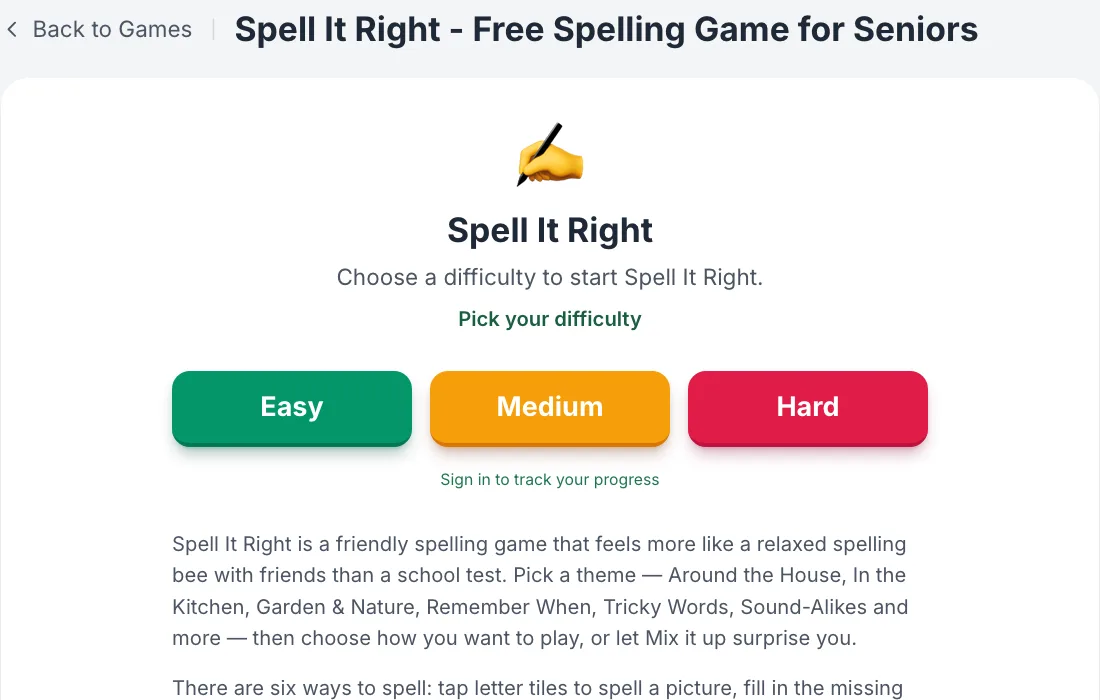
The best spelling activity is not a school test. It is a short shared word practice that respects the senior's pace, vision, hearing, and mood. This plan uses BrainFunHub's Spell It Right game, which offers easy difficulty, picture clues, read aloud words, hints, and no timer.
Quick Answer
For a calm visit, choose Easy, pick one familiar theme, and play for about 15 minutes. Sit beside the senior so you can look at the same screen. Read the clue out loud, offer one hint at a time, and stop while the activity still feels pleasant.
Use spelling games for seniors as shared recreation, not as a memory test or proof of ability. If spelling feels tiring today, switch to conversation, a simpler word prompt, or a paper activity.
Why Spell It Right Can Fit a Senior Visit
A spelling game gives the visit a clear beginning. The player does not have to invent a topic or keep a long conversation going. The word on the screen becomes the shared focus.
Current senior activity guidance supports this kind of flexible approach. The National Institute on Aging describes enjoyable activities and social time as part of healthy aging, while noting that research is still developing and no single activity should be treated as a cure. The Alzheimer's Association also advises caregivers to focus on enjoyment, keep steps simple, and adapt when attention, vision, hearing, or energy changes.
Spell It Right connects well to those ideas because it has simple choices. Families can start with Easy, use familiar themes such as Around the House or In the Kitchen, and stop after a few words without losing the value of the visit.
A 15 Minute Spelling Game Plan
Minute 1: Set up the screen
Open Spell It Right on a tablet, laptop, or desktop. Choose Easy first. If the senior wants more challenge later, Medium can wait for another day.
Place the screen where both of you can see it without leaning. Check that glasses, hearing aids, water, and a comfortable chair are nearby.
Minutes 2 to 4: Choose a familiar theme
Ask, "Would you rather try house words, kitchen words, garden words, or words from the past?"
Offer only two or three choices if the full list feels busy. Familiar themes often work better than unusual words because they invite stories and small memories.
Minutes 5 to 12: Play slowly and use the clue ladder
Read the clue once. Pause. Let the senior try first if they want to.
If they seem unsure, use this clue ladder:
- Read the meaning again.
- Say the first sound.
- Point to one helpful letter.
- Offer two choices.
- Use the game hint.
- Say, "Let's let the game show us this one."
That last step matters. It keeps the visit kind. A skipped word can still be part of a good activity.
Minutes 13 to 15: End with one easy success
End before the senior looks tired. If a word went well, say what worked: "You noticed the first letter right away," or "That clue made us both think."
Then close the game or move to a quiet conversation. The goal is a pleasant finish, not a full round.
Ready to Use Prompts and Answers
Use these if you want a paper backup or a warm up before opening the game.
-
I give light beside a chair. What am I? Answer: lamp
-
I open a lock. What am I? Answer: key
-
I am a fruit used in pie. I start with A. Answer: apple
-
I am a yellow drink fruit. I can go in tea. Answer: lemon
-
I tell time on the wall. Answer: clock
-
I am a soft place to sit with a back. Answer: chair
-
I keep rain off your head. Answer: umbrella
-
I am a sweet baked treat for a birthday. Answer: cake
You can make any prompt easier by showing the first letter, saying the word slowly, or turning it into two choices.
How to Make Spelling Games More Accessible
Keep the setup simple. One screen, one game, one theme, and one helper are enough.
Try these adjustments:
- Use Easy difficulty at the start.
- Read every clue out loud, even when the text is visible.
- Turn off extra noise in the room.
- Let the senior point while you tap if hands are tired.
- Use the hint button early instead of waiting for frustration.
- Switch to spoken answers if typing feels hard.
- Stop after three to six words on tired days.
For more word activity options, BrainFunHub's word games for seniors guide compares online word search, word builder puzzles, trivia, and printable ideas. If spelling is too much today, a simple word search or finish the phrase prompt may feel easier.
What Caregivers Should Watch For
Watch the person's face and posture more than the score. A good activity should bring focus, curiosity, or a small sense of success. If the senior becomes quiet, tense, embarrassed, or restless, change the task.
You can say:
- "This word is a tricky one. Let's take the hint."
- "Want to choose the next theme?"
- "That was enough for today. We can come back another time."
- "Let's use this word for a story instead."
This keeps dignity at the center. The person is not failing the game. The activity is being adjusted to fit the person.
Practical Takeaways
A spelling game works best when it is short, familiar, and flexible. Start with Easy. Use one theme. Offer hints early. Let conversation count as part of the activity.
Spell It Right is a good fit when a senior enjoys words, familiar objects, simple clues, or spelling memories from school, work, recipes, travel, or home life. It is less helpful when the person is tired, worried about mistakes, or not interested in word games that day.
A calm shared activity does not need to be impressive. A few words, a few laughs, and a respectful stop can be a complete visit.